
“We hiked further up and then descended into a stairway that opened into an expansive valley with a view of Khumbu region’s biggest Sherpa village: Khumjung.”
The hike from Namche Bazaar has many trails to get to the Sherpa settlements of Khumjung Village. It consists of a scenic loop that takes you through quieter, traditional villages.
We started the day visiting Tenzing Norgay Sherpa Heritage center, where the gardens of the Tenzing Norgay Memorial is landscaped with panoramic views of the Himalayan peaks.
The trail is well-established and has a wide, steep, cobblestoned footpath winding up. At one high point on the trail, you get a beautiful view of Namche with surrounding village settlements and terraced fields where grain like barley is grown.

In due course, it leads to Syangboche airstrip which is no longer in use as the airport was permitted only for landing single engine aircraft. However, a single engine, unlike the twin engine cannot support commercial operations for passenger charter service and carrying cargo. Since the airstrip has not been in operation for so long, it has turned into an expansive grassy field that can be viewed on the way up to Sagarmatha Next, another interesting stop that’s just ahead of this area.
Sagarmatha Next is an NGO which creates awareness about waste generated by tourism. It has a learning center, a museum, an art studio with a gallery and a waste lab. The Solukhumbu region has an average of 80,000 visitors annually that generate around 200 tonnes of waste. There are 58 landfills in the region. This is an astounding number! It was an unbelievable learning experience to be aware of these facts and think about how to be better, engaged and responsible visitors.
Sagarmatha Next works in collaboration with another government organization called SPCC (Sagarmatha Pollution Control Committee) to generate reusable products and art work from some of the collected waste. They have additional programs such as “Carry me back” – crowdsourced waste removal system to transport the waste generated in the Khumbu region for its proper recycling. This is a brilliant solution promoting responsible tourism, where each tourist on their way back picks up and carries a small bag of compressed recycling waste back to Lukla from where it’s collectively flown back to Kathmandu.
One of the most immersive experiences in the museum is a 360 deg virtual reality film showing the Khumbu glacier and the setup of climbers at camp I. It was an exhilarating experience to view the Khumbu icefall right next to you and be able to walk around the glacier area near Camp 1.
One of the most profound moments at the center was when I heard this quote as I watched the film, where the narrator said:
“We are not inheriting this land from our ancestors but borrowing it from our children.”
The path going further up Sagarmatha Next has a couple of options. The trail forking to the west leads directly to the village of Khumjung – the oldest established Sherpa village in the Khumbu region. The trail that’s slightly to the east goes via Everest view hotel, one of the oldest establishments in the region offering breathtaking views of the snow-capped Himalayan range.
It was a cloudy afternoon with obstructive views and so we decided to skip Everest view hotel and take the shorter trail that would lead us straight to Khumjung village. Further east of this village is a valley area that’s 1000ft below called Kyamjuma village. Kyamjuma is another popular place to stay as it’s about the same elevation as Namche Bazaar and serves as an acclimatization day.
We hiked further up and then descended into a stairway that opened into an expansive valley with a view of Khumbu region’s biggest Sherpa village: Khumjung.

The village monastery is a must-see sight. The Hillary school and visitor center was the day’s finale that showcased Sir Edmund Hillary’s efforts to raise funds and establish the very first school in the Khumbu region.
We returned to our tea house enjoying the warmth of the chimney that was lit using dried yak dung and wood.
The next morning, as the clouds were appearing to clear, we saw Ama Damlam for the very first time in the vast distance through the clouds. Ama Damlam dominates the eastern sky and follows you throughout the trek to base camp, changing views and perspectives as you move further up.
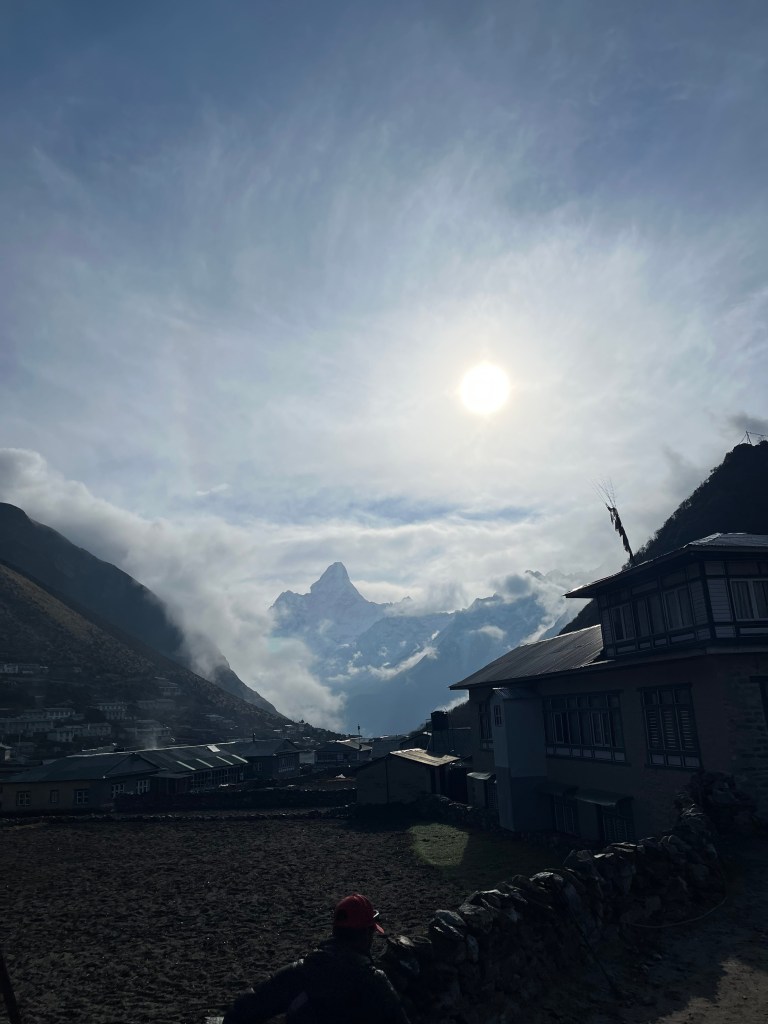
Ama Damlam translates to “Mother’s necklace”, with its long ridges on each side like the arms of a mother (ama) protecting her child.
Stats: Distance and elevation profile
Distance: 2.5 miles | Elevation gain: 1,287ft | Elevation loss: 333ft

View also…
Response
-

[…] Khumjung village gives you a different kind of experience and vibe compared to Namche Bazaar. So if you decide to stay in Namche Bazaar only for one night, you will have an opportunity to stay again upon returning back from EBC. Read more about my experience in these two villages: Namche Bazaar – the vibrant Sherpa townKhumjung – Sherpa heritage and first view of Ama Dablam […]
LikeLike

 Wanderlust On Foot
Leave a reply to Planning your Everest Base camp trek – Things to know – Wanderlust On Foot Cancel reply